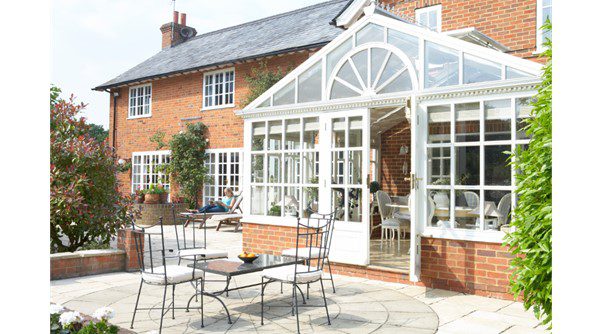
As we head into prime conservatory weather, we have compiled our ultimate guide on choosing a conservatory. We’ve included the benefits, types, issues with planning permission and the different materials you can have conservatories designed with so you can make the most informed purchase possible.
Benefits
Here at Bingley Windows & Glass, we’re so passionate about our expertly installed conservatories that we could write a whole blog just on the benefits! Some of the main benefits include:
- Creating a lighter and brighter home
- Connecting your house and garden, creating a more natural ambiance
- Adds value to the cost of your home
- Increases your energy efficiency
- Does not require any major planning permissions under new permitted extension guidelines
- Adds living space, which is more cost-effective than moving
- They are safe and secure
Types of conservatories
There are many types of conservatories nowadays, including but not limited to; Edwardian, Victorian, Lean to and Double Hipped. At Bingley Windows and Glass, we particularly love the Edwardian and Victorian-style conservatories. Here’s why.
Edwardian Conservatories
In contrast to double hipped styles, Edwardian conservatories only have 3 facets. The facet that moves away from the house can be removed which allows the roof style and glass to blend into the rest of the house. The height of the roof can be adjusted too, to your proportions which can be more aesthetically appealing in its more natural finish which makes it one of the more popular options amongst customers.
Victorian Conservatories
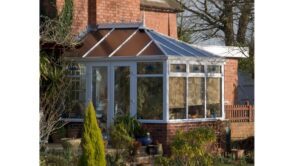
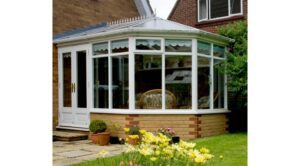
What distinguishes Victorian conservatories from other types of conservatories is the shape of the build. Typically, Victorian conservatories come in the shape of a pentagon or semi hexagon. This adds a distinct shape to your conservatory, and the facets are present on each section until it connects to your house. The roof tiles take a triangular shape for each section until they meet in the middle, where it forms a point or mini spire. Because of the way that the roof style connects, it is suitable for all property types, older, or the more modern.
Lean to conservatories
Known for its simplicity and cost-effectiveness, the lean to conservatory has a very simple structure. The roof leans in a slanted fashion towards the house. In terms of shape, these usually come as square or rectangular rooms.
Double hipped conservatories
Similar to Edwardian-style conservatories, the double hipped contains four sloped facets for the roof that meets in the middle. Unlike the Edwardian, this creates a pointed roof that does not connect to the house or can be adjusted in connection to the house, giving it more of a modern look. The effect of this makes the conservatory look more of a separate structure.
Planning permission
Recent changes to household permitted development rights now mean that you can build a conservatory as an extension to your home, with little or no planning permission required. This also applies to front porches, and rear kitchen extensions. If you are unsure or would like some reassurance as to the legality of being able to create a conservatory, you can contact your local council, or reach out to us for a free consultation here.
What is the best materials to choose for my conservatory roof?
Three of the most commonly floated materials for conservatory roofs include solid tiles, polycarbonate and glass. Let’s look at some of the tables below to see the advantages and disadvantages:
Solid tile roofs
| Advantages | Disadvantages |
| – With Edwardian and Victorian styles, this can blend seamlessly into your house. | – Can remove a source of natural light by covering the ceiling of the conservatory. |
| – Most expensive option of roof compared to glass or polycarbonate. |
Polycarbonate roofs
| Advantages | Disadvantages |
| – The current cheapest option on the market. | – Because of its cheap cost, this is also one of the less durable materials over time. |
| – Easy to mould to any shape or type of conservatory. | – Considerably also an advantage, heat outside will magnify heat inside, but to sauna-esque temperatures. |
| – Adds transparency – you can opt for a more transparent or opaque roof depending on the amount of natural light you desire. | – Can create a cheap murky look in comparison to glass. |
| – Noisy – when raining this can create a harsh effect depending on the heaviness of downpour, or with hailstones. |
Glass roofs
| Advantages | Disadvantages |
| – Better insulated than Polycarbonate roofs. | – More expensive than Polycarbonate. |
| – More regarded as aesthetically pleasing to look at than plastic. | – Furnace levels of heat during summer, and colder during winter despite heat retention. |
| – Retains more heat during winter. | – Less likely to add value depending on the buyer. |
| – Allows for more natural light, airiness and brightness. | |
| – Long-lasting and durable. Also very easy to install. |
So there we have all of the main considerations for choosing your conservatory! If you are looking for industry experts who can advise on a range of styles and materials for your conservatory expansion, please get in contact with us here at Bingley Windows and Glass here today!
Why Choose Bingley Windows
Fast Response
Whether call or email, we aim to get back you regarding your quote or query as fast as possible.
Competitive Quotes
All work carried out is completed to the highest standard and priced fairly. We never overcharge for work.
Local and Recommended
We pride ourselves on our positive reputation and ensure all our customers are left with a great service.