
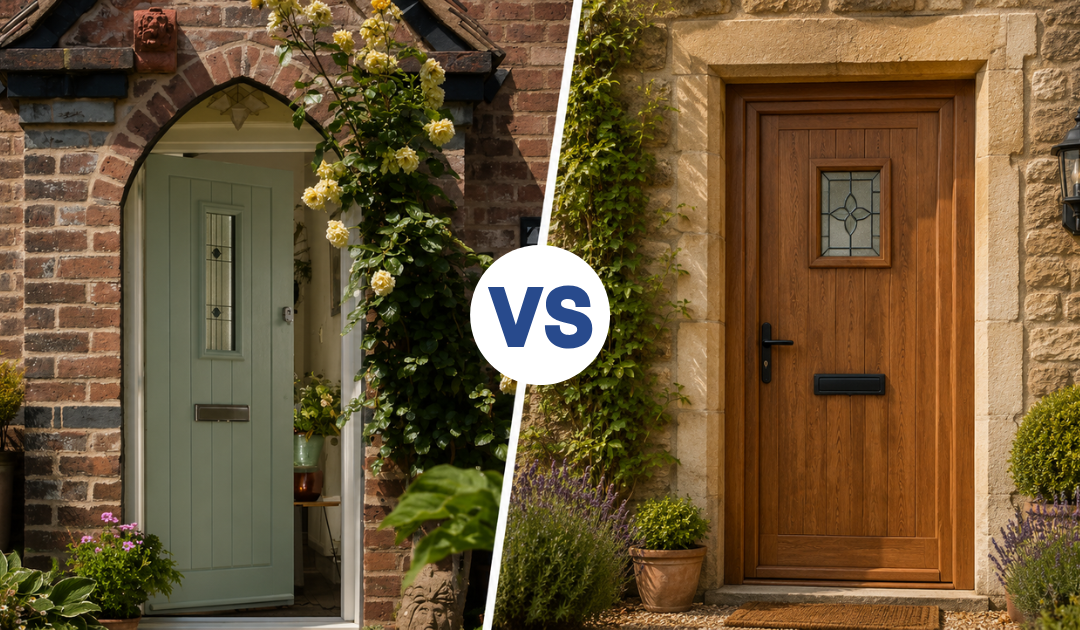
Your front door does more than welcome you home. It plays a major part in your kerb appeal, the security of your household, and how much heat escapes on a cold winter’s evening. With so many options on the market, two materials consistently come up in conversation: timber and composite. Both have a loyal following and both can look fantastic, but they perform very differently once you look beneath the surface. In this article, we’ll compare composite and timber doors on appearance, security and energy efficiency, and long-term cost and maintenance, to help you decide which is best suited to your home.
Appearance and Character
Timber doors have an undeniable charm. The natural grain, the weight, the slightly imperfect character of real wood, it’s a look that suits period homes, cottages and Victorian terraces particularly well, and it’s often the reason homeowners are reluctant to part with their original front door.
The good news is that modern composite doors have closed much of this gap. Today’s composite ranges come with woodgrain effect finishes, a wide choice of colours, and glazing and hardware options that mirror the elegance of traditional joinery. Many homeowners are pleasantly surprised at how convincingly a composite door can recreate a timber look from just a few feet away, while avoiding the drawbacks that come with the real thing. If you love the character of wood but want a door that performs better day to day, composite is well worth considering.
Security and Thermal Performance
Security and energy efficiency are where the differences between timber and composite become most apparent.
Timber is a strong material, but it’s also a natural one, meaning it can swell, shrink and warp with changes in temperature and moisture. Over time, this movement can affect how well a door seals against its frame, weakening both its insulation and its resistance to forced entry.
Composite doors are built specifically to avoid this. Combining a solid timber or foam core with a tough GRP outer skin, they hold their shape in all weathers. Most composite doors meet PAS 24 security standards and carry Secured by Design accreditation, supported by multi-point locking as standard.
Thermally, composite doors typically achieve U-values of around 1.0 to 1.4 W/m²K, compared with roughly 2.5 to 3.0 W/m²K for a traditional timber door. In practical terms, that means less heat lost through your front door and a warmer hallway in winter.
Cost, Maintenance and Lifespan
On paper, timber doors can sometimes look like the more affordable option, particularly at the budget end of the market. But the full cost of a timber door only becomes clear over time.
To stay looking and performing at its best, a timber door typically needs repainting or re-treating every two to five years, along with regular checks for swelling, rot or movement. Skip this maintenance and its lifespan, and its performance, can shorten considerably.
Composite doors ask far less of you. There’s no painting, sanding or treating required, and a quality composite door is designed to resist warping, fading and rot for 30 years or more with minimal upkeep. While the upfront cost is generally higher than a basic timber door, the reduced maintenance and longer practical lifespan make composite the stronger investment for most homeowners over a decade or two.
Final Thoughts
Timber still has its place, particularly for listed buildings, conservation areas, or homeowners who want the absolute authenticity of real wood. For most households, though, composite doors offer the better all-round package: a similar look, stronger security, better insulation and considerably less maintenance.
If you’re weighing up your options, our team here at Bingley Windows & Glass can talk you through our composite door range and help you find a style that suits your home. Get in touch to discuss your new front door today.
If you’d like to book in an initial consultation you can contact our team using the contact form here, or call us on 01535 958 183 to arrange a free consultation.